Cover Story 1: MAHB needs ‘stability’ that doesn’t change with the government — chairman
This article first appeared in The Edge Malaysia Weekly on May 19, 2025 - May 25, 2025
MALAYSIA Airports Holdings Bhd (MAHB) saw 93.8 million passengers pass through the 39 airports it manages in 2024, a 14.5% increase compared with 2023, and is on track to surpass 2019’s 105.2 million passengers this year.
It is also poised to make 2024 its third consecutive profitable year since the Covid-19 pandemic. Net profit was RM606.16 million in the nine months ended Sept 30, 2024 — more than double the RM255.47 million recorded the year before.
However, these achievements have been overshadowed by ongoing issues with the aerotrain service at Terminal 1 of Kuala Lumpur International Airport (KLIA). Frequent breakdowns have drawn significant public criticism, culminating in the suspension of services in March 2023. The continued delay in resuming operations has only added to the frustration, putting additional pressure on the airport operator to restore confidence.
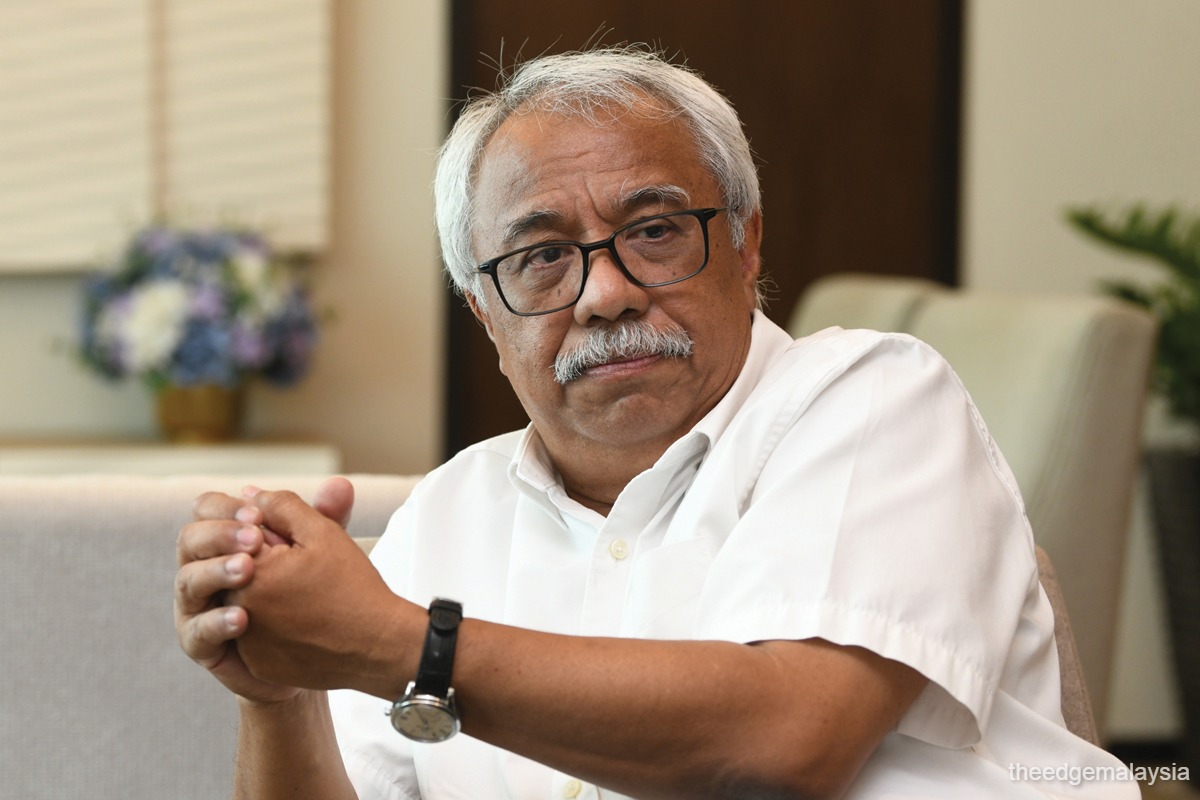
MAHB non-executive chairman Nungsari Ahmad Radhi posits that this delay was partly the result of changes in top management and board composition, which disrupted the group’s decision-making process. One such decision involved replacing the aerotrains, which have been in service for 27 years. Transport Minister Anthony Loke was reported as saying that the aerotrains had a 25-year operational lifespan.
“We’ve come from years of changes in government and prime ministers. This also led to leadership changes at government-linked companies like MAHB,” Nungsari tells The Edge in an interview.

He expresses hope that the privatisation of MAHB will lead to a period of stability for the airport operator, noting that “it’s difficult” to build and execute a long-term strategy when the group has had five CEOs or managing directors (MDs) over the past decade. Datuk Mohd Izani Ghani has been MD of MAHB since August 2024.
In fact, the role of chairman at MAHB had undergone three changes since 2019 before Nungsari was appointed to the position in May last year.
He believes that MAHB has been unfairly characterised as being slow to act in the aerotrain saga, particularly for allegedly waiting until the system failed before initiating its replacement. Critics have pointed out that MAHB knew it had to replace the aerotrains in 2016, but only decided to replace them in late 2021.
“We need stability. MAHB has professional engineers who are fully capable of managing its assets. But when top management and board members keep changing, decisions get delayed, and progress becomes difficult,” says Nungsari, who served as executive chairman of the Malaysian Aviation Commission (Mavcom) from July 2018 to April 2020.
Nungsari, known as a prominent economist, currently sits on the Policy Advisory Committee to the Prime Minister as well as Bank Negara Malaysia’s board as an independent non-executive member.
“In recent years, the tenures of MAHB’s CEOs and MDs have also been relatively short, and that is not fair to the company. We need to put systems in place that do not change with every government that comes to power,” he adds.
Nevertheless, Nungsari concedes that there is still room for improvement at MAHB.
“Okay, I’ll take the blame where it’s due. For example, we could have handled the 2019 system outage at KLIA better. [It disrupted operations for nearly four days.] Our contingency planning could have been stronger and, yes, there was under-investment in this instance,” he adds.
“We need to improve operational implementation and efficiency. While execution happens daily, planning requires a longer-term horizon. First, we need to ask ourselves: Where do we want to be? With the presence of GIP (Global Infrastructure Partners), it brings an added international perspective to the organisation.
“That said, to be fair, the group was already quite international even before this because aviation is, by nature, a global business. We work with international airlines and organisations such as the International Air Transport Association (IATA), the International Civil Aviation Organization (ICAO) and Airports Council International (ACI). Still, GIP adds further depth to that international outlook,” says Nungsari.
The group has committed to ensuring the much-anticipated aerotrain replacement at KLIA is on track to be operational by the second quarter of this year. The new aerotrain is currently undergoing test runs, according to MAHB.
“Personalities — such as the chairman or board members — can change, but the way the group operates and its long-term view must offer certainty to allow for proper planning. This is because airport expansion requires significant capital expenditure (capex). For example, the expansion of Penang International Airport (PIA), which will increase its capacity from 6.5 million to 12 million passengers annually upon completion in 2028, is estimated to cost RM1.5 billion,” says Nungsari.
He points out that the group cannot take a piecemeal approach to investment. “You can’t just add two or three gates — it doesn’t work that way.
“Second, we must understand the trade-offs. There needs to be a balance between building practical, efficient airports and the desire for visually impressive airports like Mumbai’s Chhatrapati Shivaji Maharaj International Airport and Beijing International Airport.
“I think Singapore’s Changi Airport strikes that balance well — it’s highly efficient while still offering an excellent transit experience.”
National policy to put money in right places
In February this year, MAHB was taken private by the Gateway Development Alliance Sdn Bhd (GDA) consortium for RM12.3 billion, or RM11 per share. The consortium comprises Khazanah Nasional Bhd, the Employees Provident Fund (EPF), the Abu Dhabi Investment Authority (Adia) and New York-based GIP.
Following the privatisation, Khazanah and EPF now jointly hold a 70% stake in MAHB, while the remaining 30% is owned by Adia and GIP.
“As a private entity, MAHB now has greater flexibility to focus on strategic growth initiatives without the constraints of public market pressures.
“The privatisation also allows MAHB to take a longer-term view on investments and operational improvements that may not have been feasible under public ownership,” explains Nungsari.
Already, MAHB has hit the ground running. The company recently completed upgrading works at Sultan Azlan Shah Airport in Ipoh, Perak, and expansion works at both PIA and Kota Kinabalu International Airport are proceeding as scheduled. New projects at Miri Airport in Sarawak and Tawau Airport in Sabah are already in the plans.
Still, Nungsari acknowledges that MAHB cannot operate in isolation.
“Everyone needs to come together — the Ministry of Transport (MoT), the airlines, the Immigration Department, the Customs Department, among others — to discuss how we can collectively develop the aviation industry. It’s not just about the airport; it’s about the destination as a whole, along with all the supporting services.
“Airlines are the lifeblood of an airport. Without them, it’s not really an airport. The MAHB team has done well in bringing in a number of new destinations and airlines to KLIA. But to truly operate around the clock, we need more long-haul flights. That’s the strength of Changi Airport — it can run 24/7,” says Nungsari.
MAHB also hopes to work with MoT to develop a cohesive, long-term national policy on the development of airports. “Right now, we don’t have one. And without that strategic direction, it becomes very difficult for MAHB to plan effectively.
“People often complain about underinvestment in airports, but I don’t believe that’s the issue. The problem is not a lack of investment [per se] — it’s that the investment has been directed to the wrong places,” he says.
“MAHB needs to plan its capex with a long-term perspective. That requires a clear and comprehensive national airport policy — one that is integrated with the country’s broader infrastructure, including rail, roads, logistics and the overall transport road map. Only then can we develop a coherent strategy, because airport expansion involves significant financial investment. With a proper plan in place, we can also establish checkpoints to assess whether our traffic projections are accurate,” he adds.
Periodically, there would be reports of states wanting to build their own international airports.
However, Nungsari points out that this does not justify building airports in every location, stressing that they must be financially viable. Under the new operating agreements (OAs) with the federal government, MAHB is granted the first right of refusal to manage any new airport developments.
During the tenure of former transport minister Datuk Seri Wee Ka Siong, MoT was reportedly planning to undertake a study on the National Airports Strategic Plan (NASP), with the aim of outlining long-term airport development in Malaysia based on the industry’s current needs. However, nothing materialised as Loke took over as the minister of transport in December 2022.
In an interview with The Edge in December last year, Loke said the federal government has no immediate plans to have a national policy on the development of airports for now.
“At this point in our country’s development, to say that we should come up with a policy that proclaims ‘We will not build any more airports’ does not seem fair. As far as aviation is concerned, I do not think we need to limit the number of airports,” Loke had said.
Still, MAHB needs to act quickly, Nungsari says, as Singapore recently broke ground on Changi’s Terminal 5, which is expected to open in the mid-2030s. Designed to handle about 50 million passengers a year, Terminal 5 will effectively double the size of Changi and enable it to handle 140 million passengers yearly, according to reports.
Nungsari believes KLIA holds a second-mover advantage. “If we’re good enough, we can capture some of Singapore’s traffic.”
He is of the view that KLIA stands somewhere between Bangkok’s Suvarnabhumi Airport and Singapore’s Changi, noting that Suvarnabhumi will always be larger than Malaysia’s main gateway, and the same goes for Jakarta’s Soekarno-Hatta International Airport.
“But if we are efficient and provide a good passenger experience, people will still choose to come here — because East Asia is set to grow. In the short term, there may be some challenges, such as US tariffs, but in the long run, this region will expand.
“So, if we remain efficient and deliver the right experience for both passengers and airlines, we’ll continue to attract traffic — despite competition from Changi, Jakarta and Bangkok. We can still be part of the growth story. But to claim we want to be the biggest — that’s a bit of a stretch.”
Government not selling airport assets
Nungsari reiterates that the 39 airports in the country belong to the federal government and that MAHB just operates them under a concession regime.
MAHB signed new OAs and lease agreements with the government in March last year to manage 39 airports and short take-off and landing airstrips (STOLports) in the country. The new agreements lengthen the operating period to 2069, and provide clarity on how MAHB could recover its capex on airports.
“With the new OA in place, funding for development projects has become more sustainable. The inclusion of a cost recovery mechanism ensures that capital investments are better aligned with returns, providing us with flexibility and confidence to move ahead with the necessary upgrades,” says Nungsari.
At KLIA, MAHB has introduced a range of new family-friendly facilities as part of its aspiration to create a more caring, engaging and future-ready airport experience for all. Among the latest additions are the Orangutan Playground Kids Zone, push-assist wheelchairs, baby strollers, heritage-themed feature walls and dedicated family parking lots.
“We’ve also added more seating, refurbished the surau facilities, introduced new baggage trolleys and enhanced our buggy service,” says Nungsari.
“People have to give credit to MAHB. It understands the airport business, traffic patterns and airlines. If it recommends improvements, whether it’s adding capacity, investing in assets to enhance the passenger experience or making airlines happier, we should listen,” he notes.
“The new shareholders (GDA) should allow the group to manage the procurement process. The group not only understands the capex trajectory outlined in the master plan, but is also best positioned to execute it effectively. That said, we defer to the government’s decision, as it owns the assets. The government will finance the expansion by offsetting the cost against future user fees and allowing us to recover part of it through an increase in the passenger service charge,” he says, adding that MAHB remains an AAA-rated company by RAM Ratings and A3 by Moody’s, enabling it to raise funding at very competitive rates from the capital market.
Meanwhile, the big unknown for the global aviation sector is if the US’ tariffs will result in supply and demand disruptions.
Nungsari thinks if US President Donald Trump continues on this path of imposing tariffs, it could have a dampening effect on the global economy.
“Even if he backtracks, which many are hoping for, the damage has already been done. Trade wars are never good for the economy, and when the economy suffers, so does air travel.”
Aviation analysts say it is still too early to assess the eventual impact of the tariffs on the aviation industry.
In a recent interview with The Edge, Mavcom executive chairman Datuk Seri Saripuddin Kasim said the aviation regulator is maintaining its current projection for now as the impact on passenger traffic is still considered minimal.
Mavcom has projected total air passenger traffic to range between 105.8 million and 112.9 million this year, surpassing 2019 levels.
Save by subscribing to us for your print and/or digital copy.
P/S: The Edge is also available on Apple's App Store and Android's Google Play.
The content is a snapshot from Publisher. Refer to the original content for accurate info. Contact us for any changes.
Related Stocks
Comments